The Norwood scale: understand your hair loss
The Norwood scale, also called the Hamilton-Norwood scale, is the most common way to classify hereditary hair loss in men. It describes seven stages, from slightly receding temples to a narrow fringe of hair. Here you can see which stage fits you best and which graft ranges are typical for it.

Key points
- The Norwood scale classifies hereditary hair loss in men into seven stages, from slightly receding temples to a narrow fringe of hair.
- The stage shows the affected area. How many grafts are possible mainly depends on the donor area at the back of the head.
- Sudden, patchy or painful hair loss doesn't fit the scale. It should be checked by a doctor.
The seven stages and typical graft ranges
Stage 1: No visible recession
A hairline without visible recession. A hair transplant is usually not an issue at this stage.
Usually no transplant
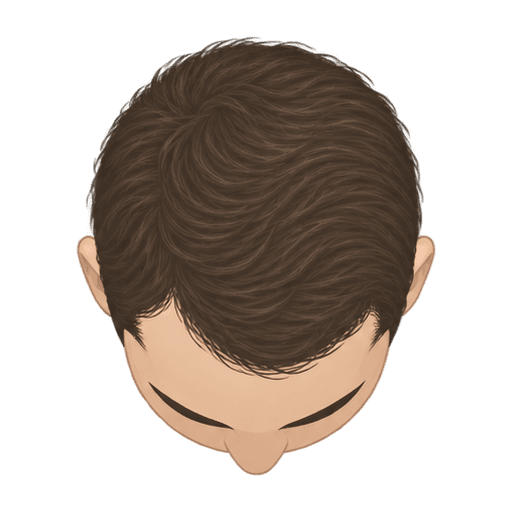
Stage 2: Early temple recession
Slight, triangular recession at the temples. The hairline moves back a little. At this stage many people first ask a doctor whether treatment with medication is an option.
about 800 – 1,500 grafts, if a transplant is done
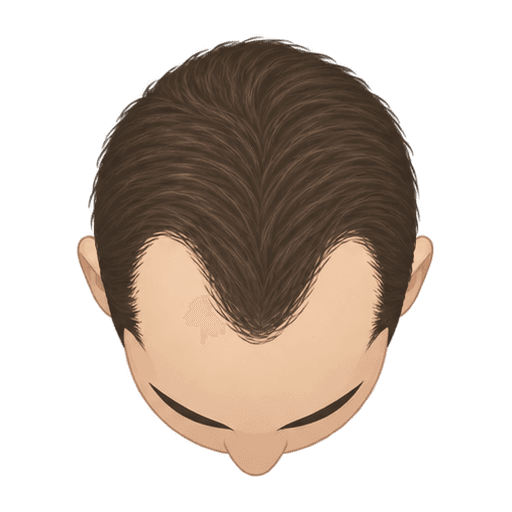
Stage 3: Visible temples
The hair loss is clearly visible, the temples have receded deeply. For some people the crown now starts to thin too (stage 3 vertex).
approx. 1,500 – 2,500 grafts
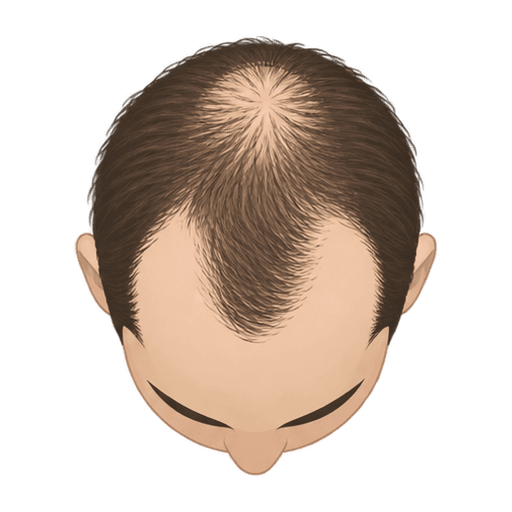
Stage 4: Advancing loss
Strong temple recession plus visible crown loss. Only a moderate bridge of hair remains between front and vertex.
approx. 2,500 – 3,500 grafts
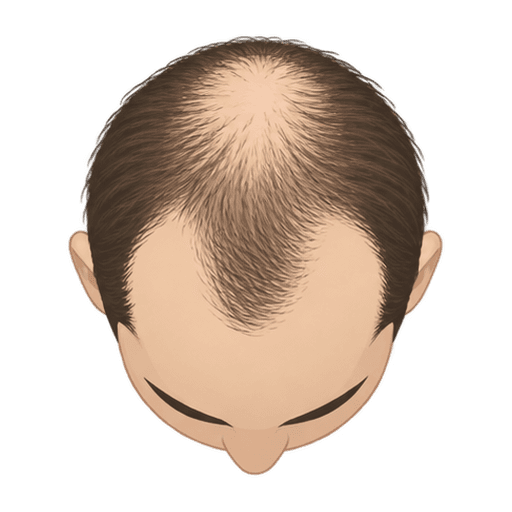
Stage 5: The bridge thins
Bare areas at the front and crown grow; the mid bridge becomes progressively thinner.
approx. 3,500 – 4,500 grafts
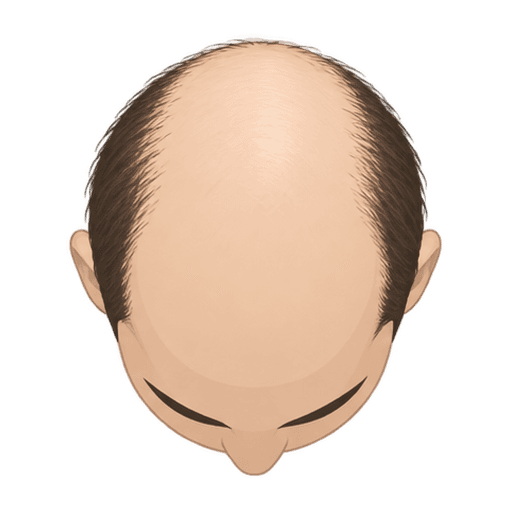
Stage 6: Front and crown merge
The bridge is gone. One large continuous bald area runs from the hairline to the back.
about 4,500 – 5,500 grafts, depending on the donor area also in two sessions
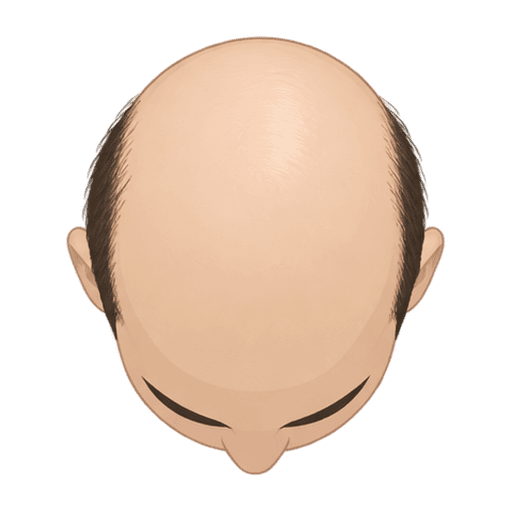
Stage 7: The horseshoe
The most advanced pattern: only a narrow band of hair remains at the sides and back.
A transplant is often only partly possible here, because the donor area isn't enough for the large area. An examination shows whether and how much is possible.
How to estimate your stage yourself
With two photos and some light you'll get fairly close:
- Photograph your hairline from the front in daylight, with your hair brushed back from the forehead.
- Have someone photograph the top of your head from above.
- Compare both photos with the drawings above. Look at the temples and whether the crown is thinning.
- If you're between two stages, choose the higher one. The clinic does the exact classification anyway.
Clinics see your stage in your photos. You simply start with the area.
Which area bothers you most?
One tap is enough, then you move on to your photos.



Your name stays with you until you choose a clinic.
Start without choosingWhere hereditary hair loss comes from
The most common form in men is androgenetic alopecia. Hair follicles on the forehead and top of the head react sensitively to the hormone dihydrotestosterone (DHT). Over the years they shrink and produce ever finer hair until they stop altogether.
Hair at the back and sides of the head is usually not affected. That's why it's suitable as donor hair: once transplanted, it generally keeps this property.
Not all hair loss is hereditary. Stress, iron deficiency, thyroid disorders, some medications or scalp inflammation can also make hair fall out. In that case a transplant doesn't help; treating the cause does.
Why the stage isn't everything: the donor area
Your Norwood stage shows how large the thinning area is. Whether a hair transplant is possible and looks natural, however, depends heavily on another factor: your donor area.
Grafts are taken from the fringe at the back of the head. If this area is dense, more grafts can be taken. If it is thin, the number is limited so that no visibly thin patches appear at the back. Only an examination shows how many it is for you.
What comes into question at which stage
- Stages 1 to 2: usually no transplant is needed yet. Many first watch how the hair loss develops and discuss with a doctor whether medication is an option.
- Stages 3 to 4: a transplant is often considered here, especially for the hairline and temples.
- Stages 5 to 6: the area is large. Whether it can be covered depends on the donor area; sometimes two sessions are needed.
- Stage 7: often only part of the area can be covered. An honest clinic tells you what is realistic.
Hair loss often keeps progressing. Good planning therefore also considers what things may look like in a few years.
And in women?
The Norwood scale describes the typical pattern in men. In women, hair usually thins differently: the hairline often stays, but the parting gets wider. There's a separate classification for this, the Ludwig scale with three stages.
Whether a transplant makes sense for women depends heavily on the cause and the donor area. This should be clarified by a doctor beforehand.
When to see a doctor
Have your hair loss checked by a dermatologist if:
- hair suddenly falls out heavily within a short time,
- round bald patches appear,
- your scalp itches, flakes, hurts or is red,
- the hair loss doesn't follow the typical pattern of the scale.
From your stage to a cost estimate
Not sure whether you're stage 3 or 4, and roughly what it costs? Upload four photos. Up to three partner clinics give a preliminary estimate of your donor area, graft count and cost. Only the examination on site sets the exact plan and final price.