Hair transplant graft calculator
Match your pattern on the Norwood scale and see the graft range clinics usually plan for the hairline, the crown, or the typical full restoration of that stage.
Key points
- A graft is a natural group of hair with usually one to three, sometimes four hairs. Clinics plan and price in grafts.
- The Norwood stage sets a typical range. Donor density, hair thickness and your goal shift the number.
- After surgery the transplanted hairs often fall out first. New hair grows after a few months, and you see the result after about a year.
Norwood stage and typical graft range
The range is the typical plan for that stage. Two people at the same stage can still need different counts.
| Norwood stage | Typical grafts | Pattern |
|---|---|---|
| Norwood 1 | Usually not needed | Little or no visible recession. A transplant is usually not appropriate. |
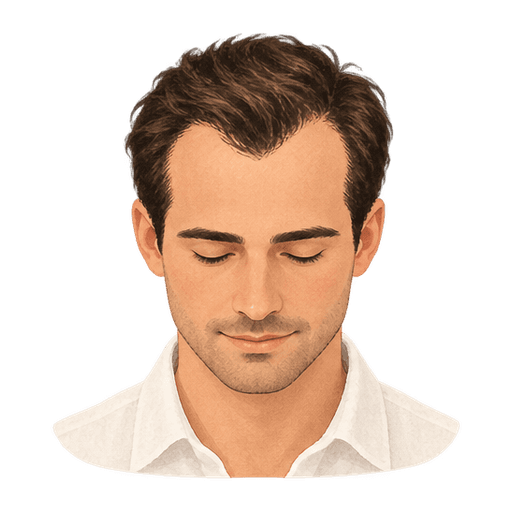
| Norwood 2 | 800–1,500 | Mild temple recession. Planning is almost always limited to the hairline. |
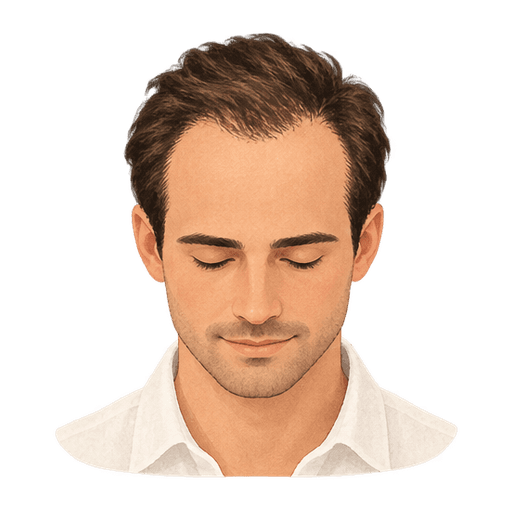
| Norwood 3 | 1,500–2,500 | Deep temple recession. The top is still largely covered. |
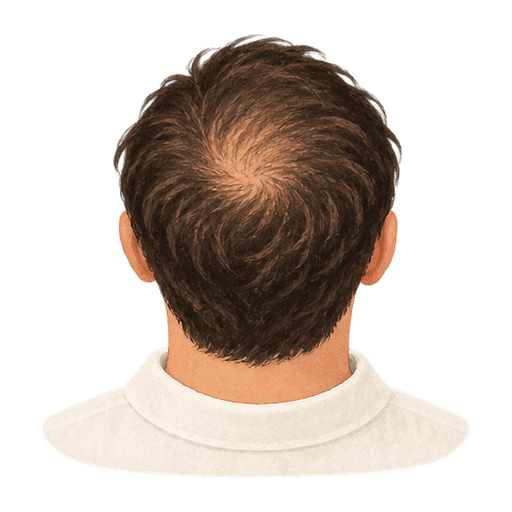
| Norwood 3 vertex | 2,000–3,000 | Temple recession plus early thinning at the crown. |
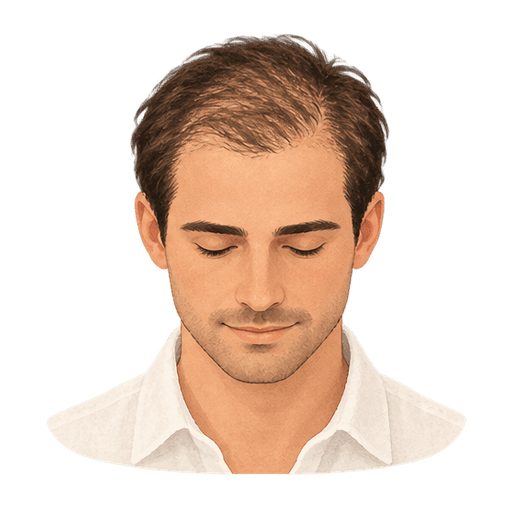
| Norwood 4 | 2,500–3,500 | Clear frontal loss and a visible crown, with a bridge of hair still between them. |
| Norwood 5 | 3,500–4,500 | The bridge narrows. Front and crown form one large area. |
| Norwood 6 | 4,500–5,500 | The top is largely bald. A band of hair remains at the sides. |
| Norwood 7 | 5,500–7,000 | Only a narrow horseshoe remains. Donor supply often caps the graft count. |
Where the ranges come from and which studies are behind them: How we calculate.
What a graft is
Hair doesn't grow individually but in small groups, the follicular units. In a transplant such a unit is called a graft and usually contains one to three, sometimes four hairs.
So the number of grafts alone doesn't tell you how dense the result will be. Two people with the same number of grafts can get different amounts of hair, depending on how many hairs their grafts contain and how thick they are.
The calculator gives a range. Clinics estimate how many grafts you need from your photos.
Which area bothers you most?
One tap is enough, then you move on to your photos.
Your name stays with you until you choose a clinic.
Start without choosingHow the Norwood scale maps to graft count
The scale runs from stage 1, little recession, to stage 7, only a horseshoe of hair. Early stages are mostly a hairline job. From stage 4 the mid-scalp and crown join in, so the graft range rises sharply.
Norwood 3 vertex is stage 3 with early crown thinning. That often adds about 500 to 1,000 grafts on top of a hairline plan. The table shows that as roughly 2,000 to 3,000 grafts.
Each stage is explained on our Norwood scale page.
What changes the final number
The same stage is not a surface area and not a donor reserve. Three things move almost every plan:
- Donor density in the fringe: it limits how many grafts can be taken without thinning the back of the head.
- Hair calibre: fine hair often needs more grafts than coarse hair to look equally dense.
- Goal: a soft hairline frame needs fewer grafts than a dense top that also closes the crown.
Many clinics price packages by graft band. Compare them on our hair transplant cost page.
How many grafts the donor area can supply
Grafts come from the fringe at the back and sides of the head. This supply is limited and doesn't grow back. The clinic therefore only takes as many grafts as it can without visibly thinning the back of the head.
How large your supply is depends on density, area and hair quality. Good photos allow a preliminary estimate, but an exact figure only comes from the examination. Because hair loss often progresses, the plan should also leave reserves for later.
One session or two?
Small to medium amounts can usually be transplanted in one session. For large areas, for example from Norwood 5 or 6, some clinics split the treatment into two sessions a few months apart.
This spares the donor area and shows how the first grafts take. Whether one or two sessions make sense is decided by the clinic after the examination.
How to use the graft calculator
- Pick a stageCompare the drawings with your hairline and, if you have it, your crown. If the crown is already thinning, choose the higher stage.
- Choose the areaHairline, crown only, or the typical full plan for this stage. The full plan matches the range in the table.
- Read the rangeYou get a planning band. Photos and an exam replace the drawing, because donor supply and your goal are not in it.
What happens after surgery
The course is a little different for everyone. As a rough guide:
- First days: the treated areas are red and small scabs form. The clinic explains how to wash your hair.
- After about 10 to 14 days: the scabs have usually fallen off.
- After 2 to 8 weeks: many of the transplanted hairs fall out. This is normal; the follicles stay in the skin.
- From about 3 to 4 months: new hair starts to grow, fine at first.
- After about 12 months: the result is largely visible; for some it takes up to 18 months.
From a range to a price you can compare
The calculator gives you a rough guide. For an assessment of your donor area, upload four photos. You'll receive up to three non-binding cost estimates from partner clinics.